
We often talk about the financial cost of owning something, including costs to buy, maintain, insure, or repair.
But there’s another cost most people never talk about. “Cost of thinking about it all the time.”That quiet, invisible cost is what I call the cognitive load of ownership — the extra brain effort you need to carry just because you own something.
People who earn lots of money but fail to properly manage it tend to lose out on a bigger chunk of their net worth eventually. A similar phenomenon is seen in lottery winners. This is due to the cognitive load of ownership – you choose to ignore this cost, but it gonna impact in other ways.
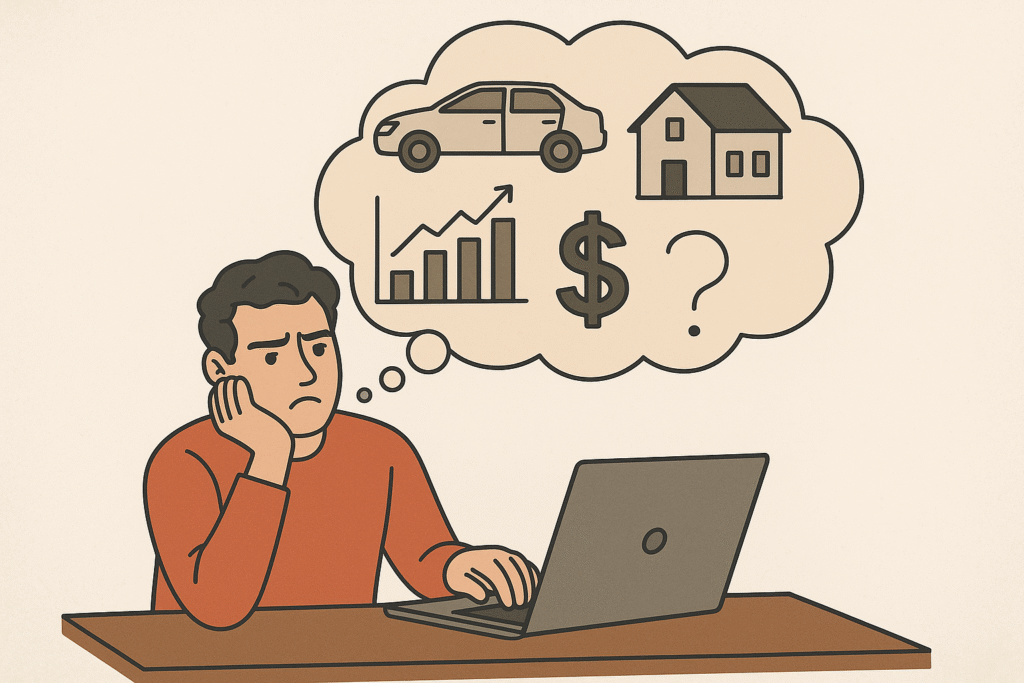
Owning Means Thinking
Let’s take something simple — you bought a stock, planning to hold it for one or two years. Now what happens?
Even though you told yourself this is a long-term investment, your mind starts checking prices, tracking news, comparing with peers, and second-guessing the decision. That “mental noise” sitting quietly in the background — that’s cognitive load.
Now imagine you bought a house. Suddenly, your mind is invaded by a long list of permanent residents:
- Leaking pipes.
- Electric issues.
- Rainwater drainage.
- Maintenance contracts.
When you own something, you also own the responsibility to fix it — and your brain knows that. That’s a cost, just not an outright financial cost.
When you rent a house from an owner, that cost disappears. The leak is someone else’s problem. Renting reduces ownership-induced anxiety.
Ownership gives control, yes — but it also gives responsibility, and that responsibility occupies mental space.
When the Portfolio Becomes a Burden
Now, let’s extend this to our investments. If you have too many assets, you start carrying mental clutter.
Each stock, mutual fund, or crypto asset you own occupies a small corner of your attention. Each one has to be tracked, understood, and revisited.
That’s asset clutter — too many open loops in your head.
And that cognitive clutter isn’t free. It quietly reduces your focus, your peace, and your ability to make clean decisions. Ideally, every new asset you add should earn enough to justify the additional mental effort it brings. Most don’t.
Suppose your friends are betting high on crypto – you have no clue about crypto, but the FOMO gets to you. You decide to invest a portion in the crypto market. Most newcomers won’t be able to manage the volatile price moments in crypto; one day it’s there, and another day it’s way outside our safety range.
This is a classic example of investing in something you don’t understand. It eats our cognitive ability, which, if used in the right manner, in things we understand, would prove to be very fruitful.
Not All Assets Weigh the Same
Let’s think of it as a framework:
Some assets naturally create more cognitive load than others.
| Factor | Effect |
|---|---|
| Higher volatility | Higher cognitive load |
| Lower volatility | Lower cognitive load |
| Higher concentration | Higher cognitive load |
| Lower concentration | Lower cognitive load |
That’s it. Simple.
If your asset keeps moving violently every day, your brain keeps moving with it. If it’s stable, your mind relaxes.
Volatility doesn’t just affect markets — it affects your peace of mind.
Bitcoin is a good example. The higher the volatility, the higher the mental load. Every time it moves 5%, you subconsciously feel richer or poorer — even if you never sold anything. And that’s exhausting.
The Invisible Burden of Property
A house property has one of the heaviest cognitive loads in personal finance. Why? Because it’s physical, emotional, and financial — all at once.
You can’t just “set and forget” a property. You worry about tenants, upkeep, local rules, paperwork, insurance, safety, and resale value.
Every crack or repair drags a piece of your attention with it.
A home is comfort for some, but for others, it’s a full-time background process consuming mental bandwidth. It’s not just bricks and walls — it’s responsibility embedded in real estate.
Cognitive Load and Decision Quality
Here’s something interesting. Higher cognitive load usually means lower decision quality.
When your mind is juggling too much, decisions start slipping through fatigue and bias.
But it’s not always that simple.
A professional investor may carry more cognitive load than a beginner — yet make better decisions because experience makes that load organized, not chaotic.
So it’s not that the load itself is bad — it’s the unstructured load that hurts. When the load exceeds clarity, it becomes noise.
“The more an asset occupies your mind, the less mind you have left for making good decisions.”
How to Reduce Cognitive Load
We can’t remove the load entirely, but we can manage it intelligently:
- Automate where possible.
Stop-losses, target sells, or auto SIPs turn decisions into systems. Systems reduce mental bandwidth use. - Hedge uncertainty.
During high-volatility periods (like elections or crises), hedge or reduce exposure. It stabilizes both portfolio and mind. - Insure major risks.
Good insurance reduces the background fear of “what if something happens.” Less fear = less cognitive drag. - Delegate complexity.
If you don’t understand it, outsource it. Hire an advisor, automate with a portfolio tracker. You’re not just buying expertise — you’re renting someone else’s cognitive bandwidth.
Knowledge Shrinks Mental Load
Interestingly, two people can hold the same portfolio but experience it very differently. One stays anxious; the other sleeps peacefully.
Why? Knowledge changes perception. Understanding what you own reduces uncertainty — and uncertainty is what feeds mental friction.
The more you understand your assets, the less they occupy your thoughts.
The Opportunity Cost of Attention
Every asset ties up not just capital, but attention. Attention is finite. If your money is compounding but your stress is too, you’re not winning — you’re just trading financial growth for mental exhaustion.
“Every rupee that compounds quietly is worth more than ten that keep you awake at night.”
Simplify. Cut noise. Own less, but own with conviction.